
Robert E Howard
Happy Birthday to a Founding Master of Sword & Sorcery

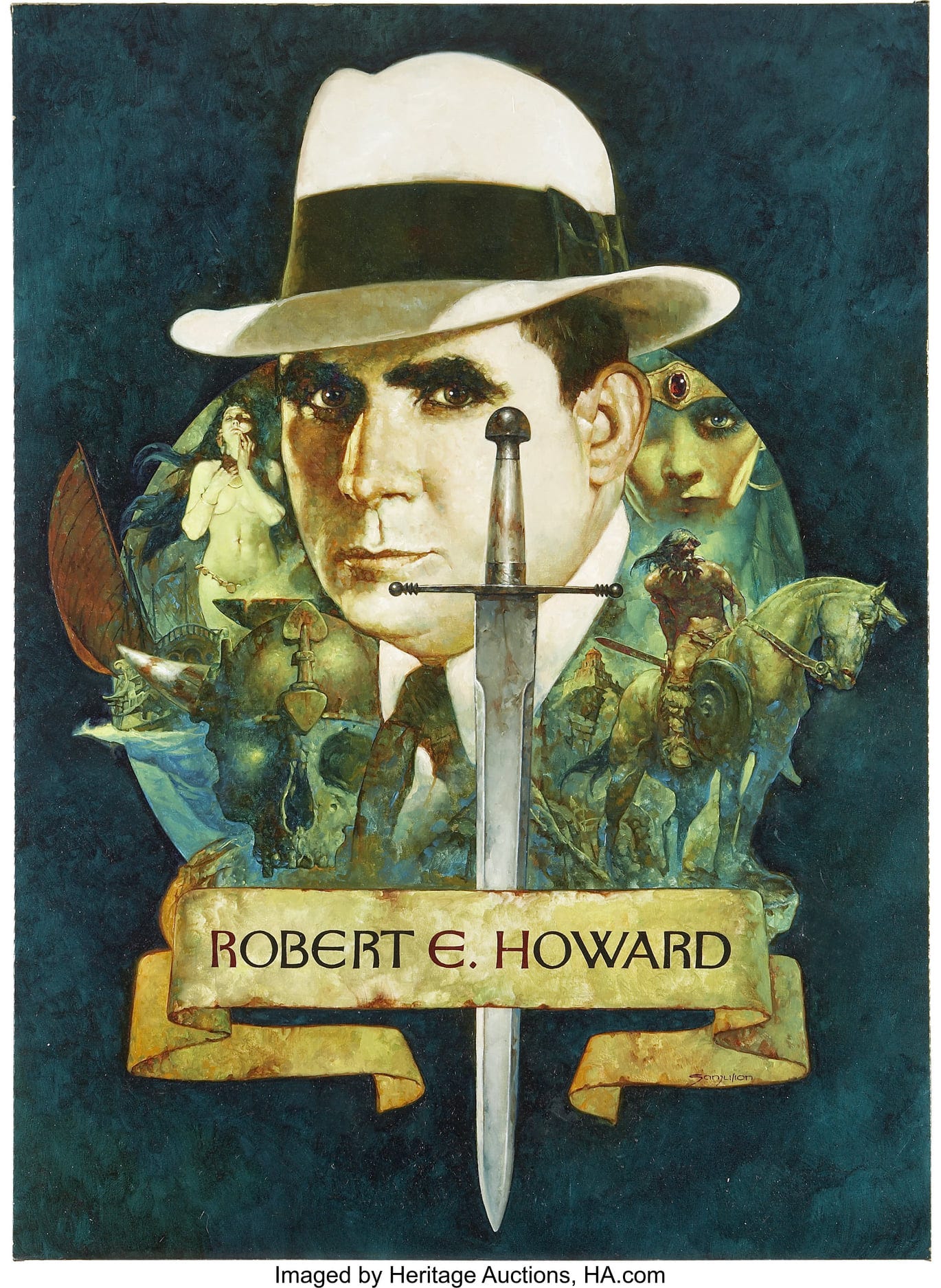
Robert E. Howard (full name Robert Ervin Howard) was an American author best known as a pioneering writer of pulp fiction, particularly in the genres of fantasy, adventure, horror, and historical fiction. He is widely regarded as the father of the sword and sorcery subgenre of fantasy literature, most famously through his creation of the iconic character Conan the Barbarian (often called Conan the Cimmerian).
Born on January 22, 1906, in Peaster, Texas (a small town in Parker County, west of Fort Worth), Howard was the only child of Dr. Isaac Mordecai Howard, a traveling country physician, and Hester Jane Ervin Howard. The family moved frequently during his early years due to his father’s work but eventually settled in the small Central Texas town of Cross Plains around 1919, where Howard lived for most of his life. He attended local schools there and showed an early aptitude for reading and storytelling, devouring books on history, mythology, folklore, and adventure literature.
Howard began writing seriously as a teenager, submitting stories to pulp magazines—the cheap, mass-market periodicals that dominated popular fiction in the 1920s and 1930s. His first published story, “Spear and Fang,” appeared in Weird Tales in 1925 when he was just 19. He quickly became a prolific contributor to Weird Tales and other pulps, often writing under pseudonyms like Patrick Ervin or Steve Costigan for different genres.
His output was remarkable for someone who died young: in a career spanning roughly 12 years, he produced hundreds of stories, poems, and essays across diverse genres. These included:
Fantasy and sword and sorcery: Besides Conan, he created Kull of Atlantis (a brooding Atlantean king), Solomon Kane (a Puritan avenger fighting supernatural evil), Bran Mak Morn (a Pictish king defending his people against invaders), and others. His Hyborian Age setting for Conan—a fictional prehistoric era between the sinking of Atlantis and the rise of known history—blended myth, history, and imagination into a vivid, gritty world of barbarians, ancient civilizations, sorcery, and monsters.
Westerns and boxing tales: He wrote humorous Western adventures featuring characters like Breckinridge Elkins and serious frontier stories. His Sailor Steve Costigan series drew on his own brief experiences as a boxer and seaman.
Historical adventure: Tales like those of El Borak (a gun-slinging adventurer in the Middle East) and others set in various eras.
Horror and weird fiction: Stories with Lovecraftian influences, as Howard corresponded extensively with H.P. Lovecraft and other Weird Tales writers.
Howard’s prose was vivid, fast-paced, and muscular, emphasizing action, raw human emotion, barbaric vitality, and a pessimistic view of civilization’s decay. He often portrayed “barbarian” characters as noble and vital in contrast to decadent, corrupt civilized societies—a theme reflecting his own disillusionment with modernity and admiration for frontier ruggedness.
His most enduring creation, Conan, debuted in Weird Tales with “The Phoenix on the Sword” in 1932. Conan is a massive, cunning Cimmerian barbarian who rises from thief and mercenary to king through sheer strength, wits, and ferocity. The stories mix sword fights, sorcery, intrigue, and exotic locales. Though only about 20 Conan tales were completed (plus fragments), they defined the genre and inspired countless imitators. Howard’s success peaked in the mid-1930s, but he earned modest pay from the pulps and supplemented income with other writing.
Tragically, Howard’s life ended abruptly. He was deeply attached to his mother, who suffered from tuberculosis for years. On June 11, 1936, as she lay in a coma with no hope of recovery, a nurse informed the family she would not awaken. Howard, who had prepared for this moment (including setting his affairs in order), stepped outside to his car, shot himself in the head with a pistol, and died about eight hours later at age 30. His mother passed away the next day. Both were buried in Greenleaf Cemetery in Brownwood, Texas.
Despite his short life and limited recognition during it—most of his work appeared only in magazines—Howard’s posthumous influence has been immense. Conan stories were collected and edited (notably by L. Sprague de Camp and others in the 1950s–1970s), leading to massive popularity in paperbacks. This fueled adaptations, including films (the 1982 Conan the Barbarian starring Arnold Schwarzenegger), comics, games, and more. His sword and sorcery style influenced fantasy writers like Fritz Leiber (who coined the term), and his work helped pave the way for modern heroic fantasy.
Howard remains celebrated for his raw energy, world-building, and unflinching portrayal of human nature. Though his personal life was marked by isolation in rural Texas, health struggles, and depression, his legacy endures as one of the most dynamic voices in 20th-century pulp and fantasy fiction.
Thanks for the bio on Howard. But please, don’t mention those execrable movies. No slam on Arnold. The writers made a hash of Conan’s backstory. I went there wanting to see sweeping Cimmerian vistas as Conan learned to climb sheer cliffs with fingers and toes. He was supposed to be a teenager during the sack of the Aquilonian colony of Venarium. Having him grow up as a slave was worse than insulting.
Somehow I missed how his life ended. I just didn't know.